Julian
Julian Weaver
Co-founder, CEO
Does the neuroscience, from fitting electrodes to training models. Co-founded Longhorn Neurotech at UT Austin.
Dydema is building brain–computer interfaces for everyone: a headset, and the AI models behind it. Pick a thought and bind it to whatever you want, like a key in a game or a command to an agent. No surgery required.
Brain–computer interfaces shouldn’t be scary or medical. You put on a headset, set it up for a bit, and use a thought like you’d use a key. Then you take it off.
That same year, Jacques Vidal at UCLA had people steer a cursor through a maze with their brain signals. It worked! Then BCIs mostly stayed in labs for the next fifty years.
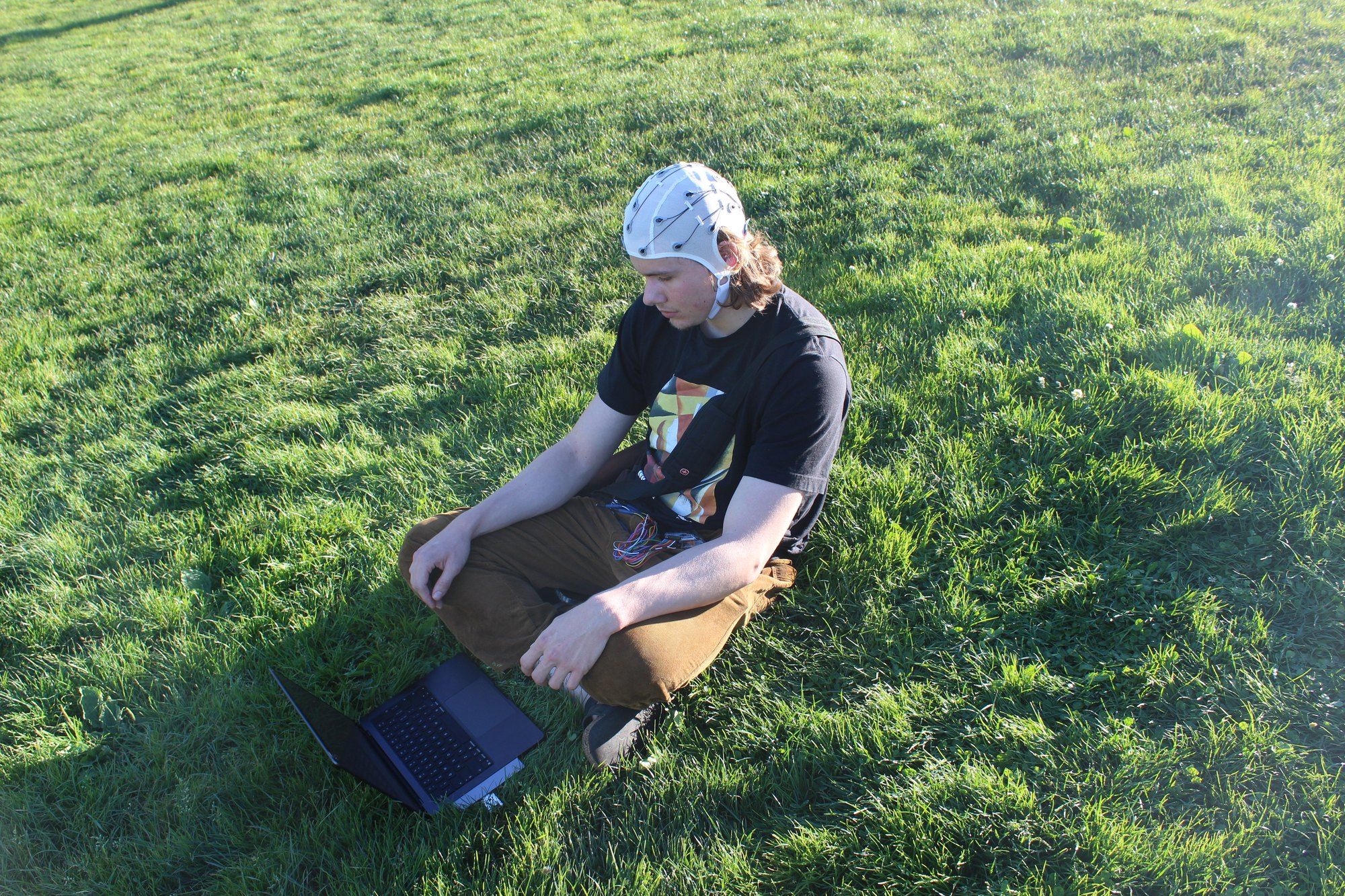
Right now ours is a research cap plugged into a laptop, plus a model that’s never seen you before. You do a short setup, pick a thought (for instance, imagining a movement) and bind it to something. On our benchmarks, our general models beat models trained only on one person’s data.
It can only tell a few thoughts apart so far. The cap is research gear while we design our own headset with cheaper sensors. Next up is more thoughts, recognized faster. If you want to build on it, we’re aiming to have v2 of our model API out by December.

Our models get better the more data we give them, so most of what we do is collecting it and cleaning it.
We’ve cleaned about 14.6 years of existing brain recordings (it was a nightmare), and we’re starting to record out in the world, not just in a lab. Most days our living room is the two of us in caps, debugging on ourselves.
Speech is about 39 bits a second. That’s the bar, and we’re a long way off. We want to make a BCI anyone can buy, and we want people using it to reach each other, not just computers.
Julian and Chris. Best friends since high school.
Julian Weaver
Co-founder, CEO
Does the neuroscience, from fitting electrodes to training models. Co-founded Longhorn Neurotech at UT Austin.
Christopher Oosthuizen
Co-founder, CTO
Builds the models and everything they run on. Before Dydema he worked on AI for problems with barely any data.